
H1 2026 Market Wrap: The YTD in Receipts
The scoreboard for H1 2026 is in.
If you only read the headlines, you’d think AI infrastructure and the chip trade were the whole story of this year’s first half.
But looking at the actual returns, a stranger picture emerges.
Of the 21 major asset classes, nineteen finished the first half in the green.
Only two did not.
Six months ago, in the first Benchmark of the year, I wrote that 2025 was the Year of the Receipt — a year that started on narrative and promise, and ended on proof.
Gold won because many investors stopped believing America’s financial promises, and started demanding proof of them.
The U.S. Dollar had its worst year in a decade, which drove capital not only into precious metals but into other country’s stock markets, too.
Well, the receipts are now in for the first six months of 2026.
The story for gold, among other fascinating narratives, is now very different.
(Nearly) all green six months in
You can click the scoreboard below for our full interactive table (h/t Charlie Bilello):
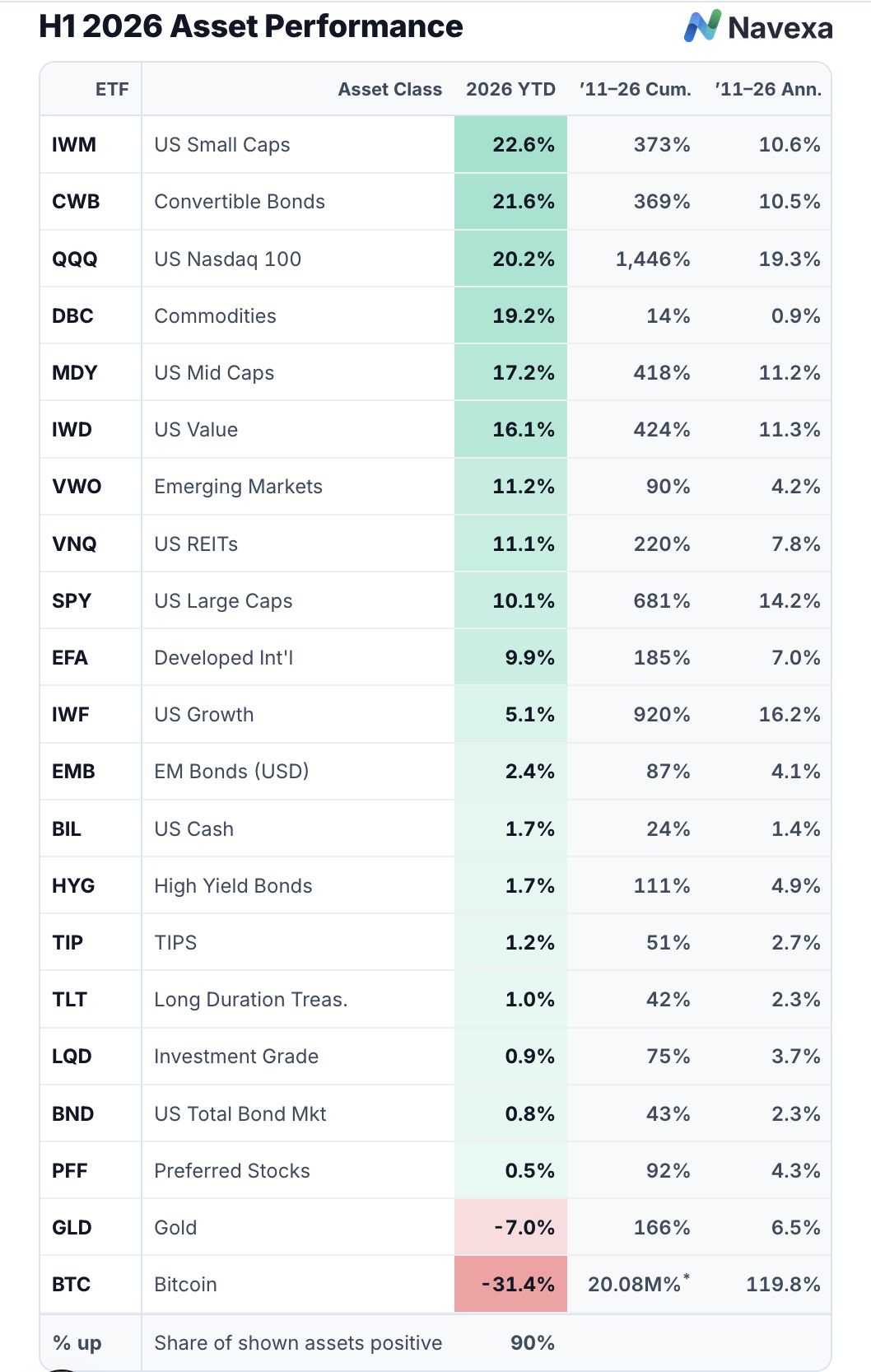
The key takeaways:
19 of 21 asset classes finished H1 2026 in the green — the only two in the red were Gold (-7.0%) and Bitcoin (-31.4%).
Gold and Bitcoin were 2025's two biggest stories (Gold +63.7%, the best performer of the year; Bitcoin weakening -6.3% after posting new highs) — both flipped to the bottom of the board in H1 2026.
Small caps led everything, up 22.6% — their best first half since 1991.
Convertible bonds (+21.6%) and the Nasdaq (+20.2%) rounded out the top three performers for H1.
Growth was not just a mega-cap story — commodities, mid caps, value, emerging markets, REITs, and the S&P 500 all posted double-digit gains.
Bonds were the boring middle — Treasury Inflation-Protected Securities, Treasuries, investment grade, and total bond market all clustered near flat (0.8%–1.7%), positive but unremarkable.
Bitcoin’s -31.4% would be a second-worst calendar-year showing on the board (only 2018’s -73% and 2022’s -65% were worse), a sharp reversal after topping the leaderboard in 2024 (+121%).
Gold's -7.0% would mark its first negative year since 2015, if it stayed here. This would end a run of five straight positive years including the +63.7% blowout in 2025.
Gold and Bitcoin are sitting exactly where you’d expect the two hedges against a weak dollar and an unstable financial system to sit — except upside down. In a half where 90% of the field made money, the two flight-to-safety trades were the only ones that lost it.
That's not supposed to happen. Gold has long been the hard asset to own when trust in the rest weakens. Bitcoin in recent years has made inroads with hard asset investors, too.
But when every other asset in the list is going up regardless of the FUD… the underperformance they purport to protect against didn’t show, despite bearish macroeconomic sentiment and Fed announcements.
The debasement trade debunked?
Gold's chart tells its own story.
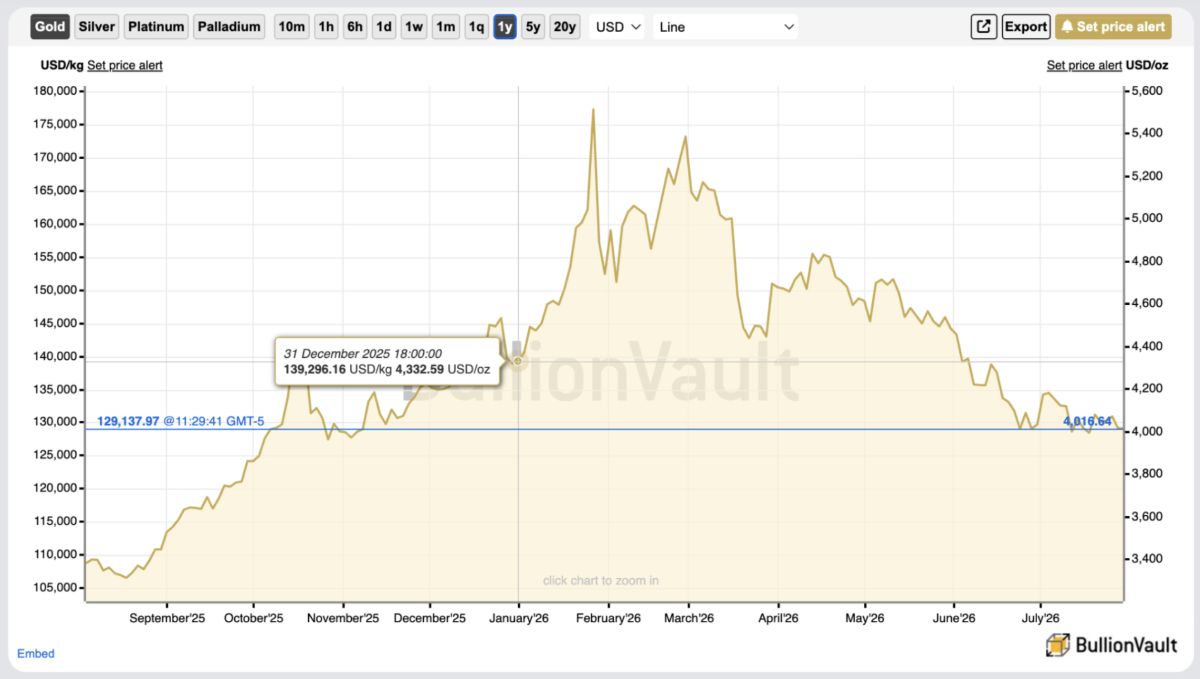
The metal opened the year already running hot off 2025’s rally, and kept going.
By late January it had touched an all-time high near $5,600 an ounce — a nearly 30% gain in four weeks.
The narrative in every note and headline was the same one from 2025, just louder.
Currency debasement. Central bank buying. A Fed under pressure. Geopolitical risk, sharpened by a war that had oil spiking and traders bracing for something worse.
The something worse didn’t arrive. The war didn’t spook the financial markets nearly as much as many expected. And the Fed — under a new chair, Kevin Warsh, confirmed into the role this year — did something gold was not pricing in at all.
The Fed triggers a dollar reversal
At the start of 2026, the bond market had two rate cuts priced in for the year.
By July, it was pricing in one to two rate hikes.
Read that again.
The market expected two interest rate cuts in January, and now it’s pricing in the exact opposite.
The reversal is worth almost a full percentage point of expected policy.
With inflation stuck (Core PCE at 3.4%, its 63rd straight month above the Fed's own 2% target) and Warsh telling his first press conference that the commitment to actually hitting that target was “strong, unanimous and unambiguous”.
The dollar, which had spent 2025 quietly collapsing, did what dollars do when real rate expectations move a full point in six months. It rallied to a 13-month high.
Gold, priced in the no longer debasing dollar, gave back its entire January spike and then some.
This is the part of the story that stings a little for those who bought gold at $5,600.
Gold didn’t get sold because the debasement story was wrong. It got sold because the debasement, for now, paused. The metal was pricing in a promise about the dollar’s future that the Fed then declined to keep.
Proof, in other words, showed up. It just wasn't the proof gold’s buyers were positioned for.
Michael Burry vs. the AI industrial complex
One Boise, Idaho company has had one of the stranger six months in corporate America so far this year.
Micron doesn't run on narrative. It runs on DRAM and NAND — unglamorous memory chips that every AI data centre on earth is currently short on.
On June 24, the company reported quarterly revenue of $41.5 billion, up 346% from the same quarter a year earlier, its fifth consecutive quarterly record.
Every single figure in the report beat Wall Street's estimates, some of them by billions.
This isn't the AI story we've grown used to. A hyperscaler promises transformative returns on capital it hasn't spent yet. Micron was already selling every chip it could make. Sixteen customers had signed multi-year, take-or-pay supply agreements just to guarantee they'd get product. The proof had arrived, audited and filed with the SEC.
The stock had already run more than 240% year to date by the start of July, on its way to a market cap above $1 trillion.
And then, on July 2, Michael Burry — the investor who built his reputation shorting a bubble everyone else insisted wasn't one — disclosed a short position against Micron at $1,051.87 a share.
Micron, he pointed out, has had 34 separate drawdowns of more than 30% across 42 years of trading, a return on invested capital of roughly 4%, and a habit of destroying capital in one quarter out of every three, historically. He called the current rally a case of fear of missing out meeting a greater-fool market, dressed up as an AI supply story.
Burry is one of the most prominent AI skeptics:
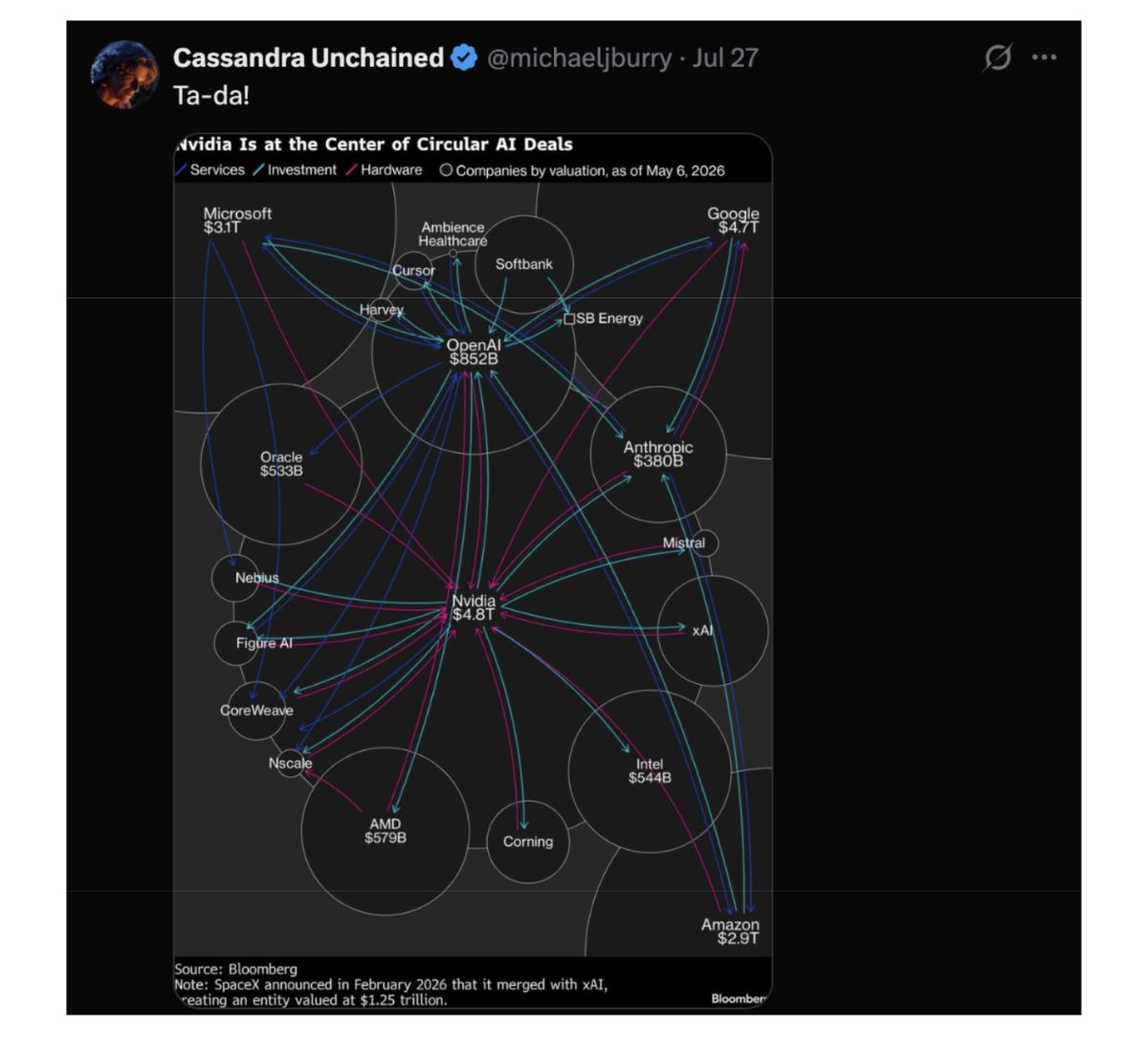
But as far as Micron goes, the revenue is real. So is the cycle. Micron's own history is the best evidence for Burry's case, and its own most recent quarter is the best evidence against it.
A great quarter doesn't retire a bad chart, in the same way a bad six months doesn't retire a good decade.
The market seemingly spent the first half of 2026 handing out report cards to every asset that had gotten too comfortable with its own narrative — gold's fear story, Bitcoin's debasement story, and now, quietly, memory chips' infinite-demand story.
Some assets got graded down. Micron, so far, has not. That verdict isn't final, of course. We’ll see how these narratives interact over the next five months.
The rest of 2026
The first half of the year has revealed some major capital rotations amid unexpected macro and monetary policy shifts.
Gold's debasement story, while intact, went stale as a mainstream, urgent narrative.
The dollar had been sliding for a year. But the day the Fed signalled it might hike rates again, gold quickly weakened in price and demand.
That's the thing worth watching through the back half of the year. None of this is settled.
As I write this, stocks are near all-time highs yet again.
And yet:
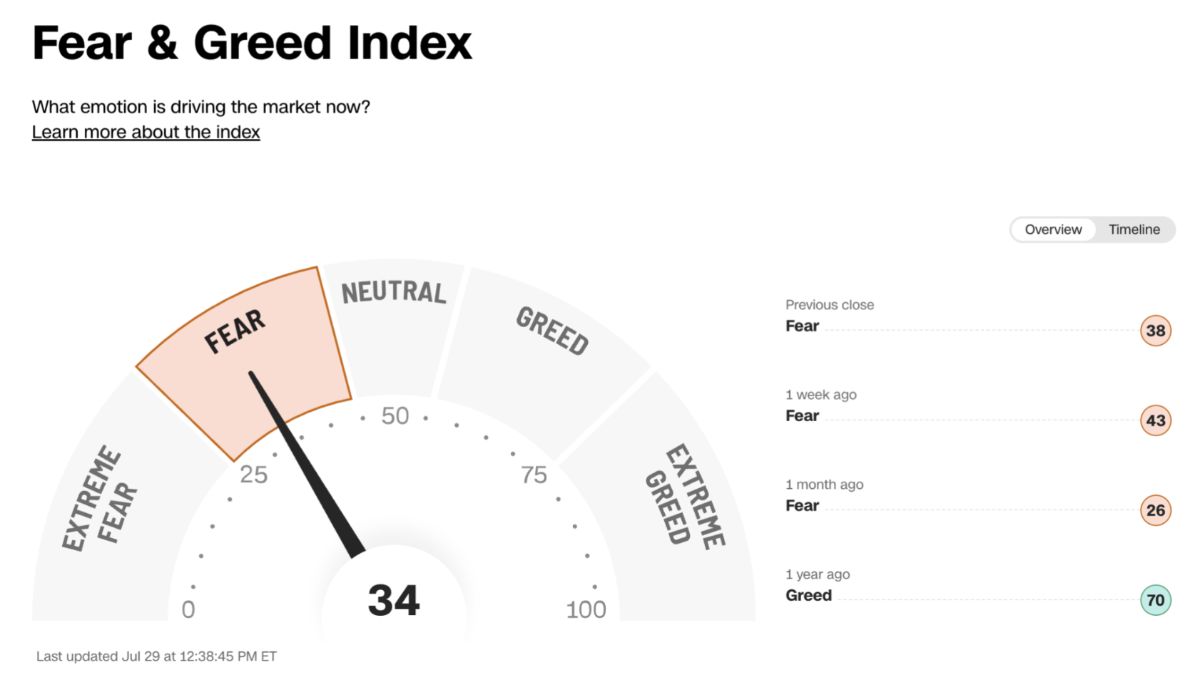
The Fed's shift from two priced-in cuts to talk of a hike rests on core inflation staying stuck near 3.4%. One soft print between now and September could put cuts back on the table. If it does, the dollar's rally likely stalls, and gold's case reopens almost exactly where it left off in January.
Micron is running on a shorter clock. HBM is sold out on paper through the rest of 2026. Whether that holds depends on whether the sixteen supply agreements signed this year turn into shipped product before South Korea's expanding capacity starts showing up in prices. Burry's short doesn't need Micron's business to collapse. It only needs the next quarter to look less extraordinary than this one.
Bitcoin sits downstream of the same mechanism as gold, minus the metal's excuse of physical scarcity. If the dollar keeps climbing, expect more of what H1 delivered. If it doesn't, the loudest comeback story of the second half might be the one nobody was writing about in July.
If the past 18 months has been anything to go by, then it’s safe to assume that when I write to you with the 2026 full-year wrap, the assets and sectors that win and lose might look very different from expectations and forecasts.
Key numbers to watch? Core PCE. And the dollar index.
This week's quote:
"It ain't what you don't know that gets you into trouble. It's what you know for sure that just ain't so."
— attributed to Mark Twain
Invest in knowledge,
Thom
The Benchmark
Read more: What the rai stones of Yap reveal about our financial system.
Share: Forward this email to someone you know would appreciate it.
Connect: Add me on LinkedIn
Become a reader:Subscribe to The Benchmark.
Enjoyed this issue?
Subscribe to The Benchmark
Weekly insights on markets, investing, and portfolio strategy.