
Navexa Live: One VAS sale, three parcel choices
Watch James compare three ways to match the same sale to VAS parcels. Get the Claude prompt, slides and replay, plus demos of single-day returns, Calendar and chart events.
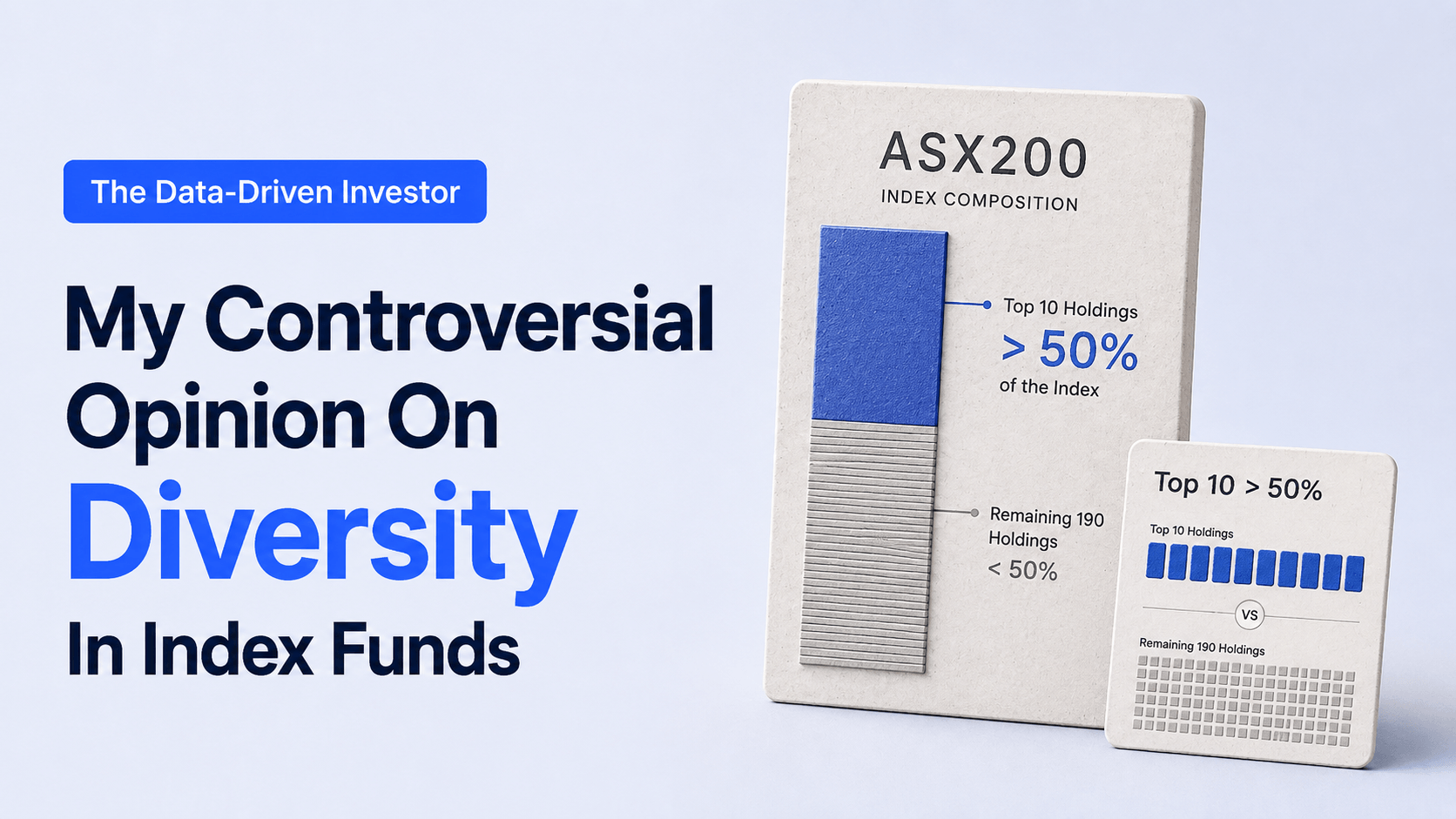
A lot of people talk about buying index tracking ETFs.
Finfluencers.
Gurus.
Friends.
Even Warren Buffett has promoted index tracking ETFs.
The idea behind this is that you get decent diversification relatively easily.
As we learn early in our investing careers, diversification is a good thing, right?
Right?
Well, it depends on how you define diversification.
Is it owning multiple stocks?
Is it owning multiple stocks across different industries?
Do these stocks need to be of equal value in your portfolio?
Do these stocks need to be from different countries?
There are many different ways to diversify.
Note: Absolutely none of what follows should be considered financial advice — merely a personal investigation into the numbers behind diversification.
The ASX200 index covers the top 200 companies listed on the ASX.
And there are many ETFs out there that track this index.
Buying into one of these would give you broad diversification in terms of number of companies.
But how diverse is the ASX200 really?
With a little bit of digging, you will find that the top 10 stocks in the ASX200 makeup more than 50% of the index’s total market capitalization.
In other words, the ASX200 is very top heavy.
BHP is the number one stock in the index, with a market cap of ~$200 billion.
Compare that to the 200th stock in the index, with a market cap of $1 billion.
This means if BHP has a bad year, it can significantly impact the whole index.
So what does this look like in a real portfolio?
Let’s take a look at a theoretical portfolio made up of the top 10 ASX stocks in 2018.
Let’s call it the ASX10.

In the past five years, the ASX10 has outperformed the ASX200 index.
With capital gains and dividends included, the ASX10 achieved a return of 12.45% p.a. — outperforming the ASX200’s return of 9.81% p.a.
You can see from the chart that the movements were almost identical the whole way through.
But the ASX200 had 190 other companies influencing its overall performance.
So while you get diversification from an ASX200 index fund, is it the kind of diversification you want?
To be clear, I’m not saying investors shouldn’t buy index funds.
If it’s between doing nothing with their money or investing at all, then index funds might be a great idea.
They do, after all, track the performance of an index — most of which, over the long term, tend to go up.
But for those of us who pay closer attention to what we’re investing our money in…
And those — like me — who unashamedly ‘nerd out’ on every detail of our investments…
It’s worth noting that there can sometimes be hidden costs — or rather opportunity costs — to simply buying an index fund versus investing in a particular cohort of companies.
Diversity has become one of those pieces of financial jargon people perhaps automatically presume to be admirable.
But, as I like to say, the numbers never lie.
Always do your own research — this is not advice and always remember that past returns are never a guide for future performance.
Knowledge pays the best interest,
Navarre
The Data-Driven Investor
Track your portfolio in Navexa
Free 14-day trial. No credit card required.
Try Navexa Free →Watch James compare three ways to match the same sale to VAS parcels. Get the Claude prompt, slides and replay, plus demos of single-day returns, Calendar and chart events.
Four ETFs held more than 1,000 companies, yet five accounted for 19.4% of the money. Navarre Trousselot traces the overlap and shows you how to find your own top ten.
Watch the 18 November replay for custom price imports, an AMMA statement in Roi, a Pareto chart, and benchmark analysis in Claude. Get the slides and prompts.