
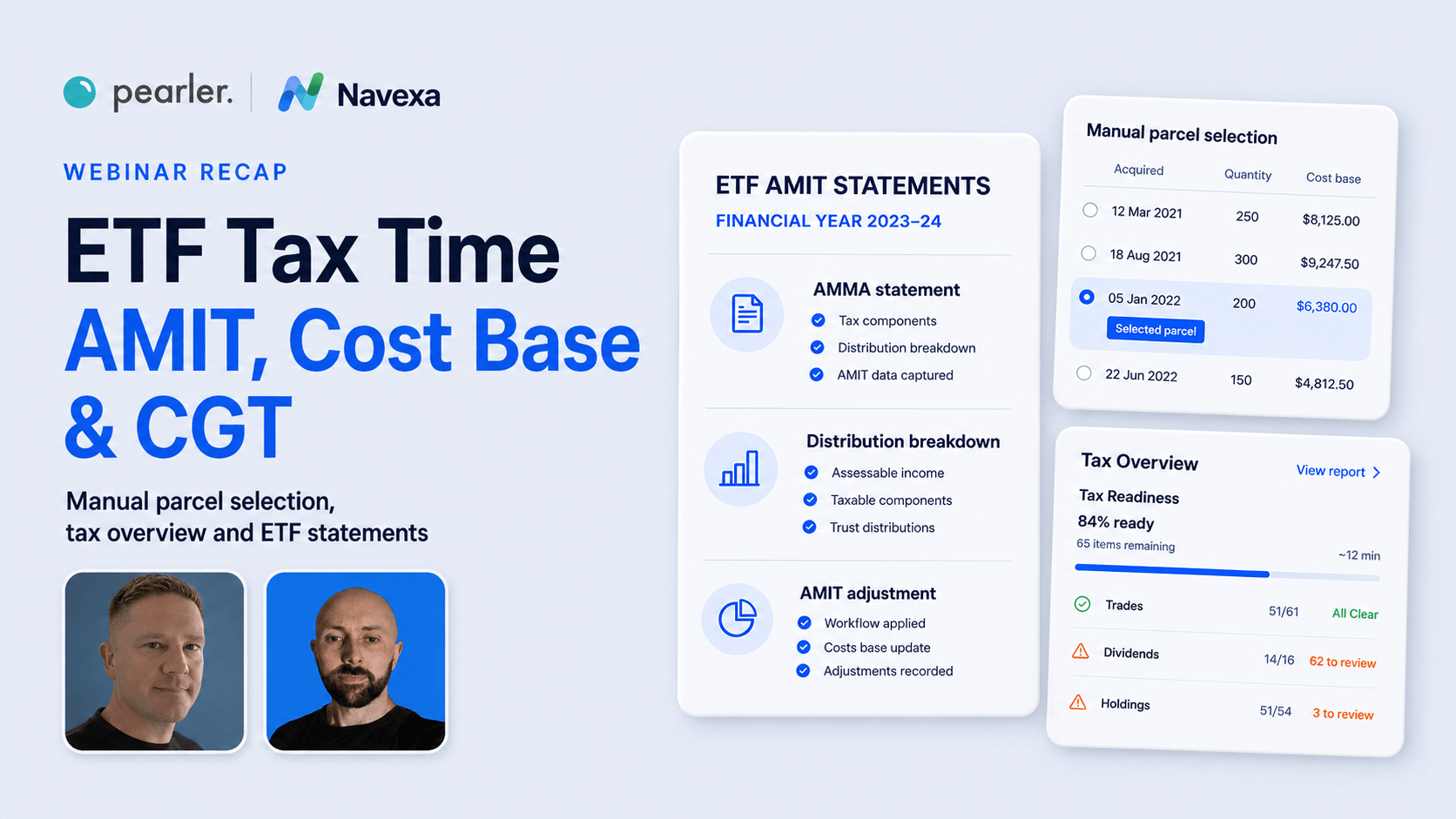
An AMIT cost-base adjustment changes the tax cost of your ETF units. An AMIT excess decreases the cost base; an AMIT shortfall increases it. Use the net adjustment shown on your final AMMA statement when updating your records.
This guide explains the statement terms, shows worked examples and walks through recording the information in Navexa. It builds on our ETF tax webinar with Pearler, with the replay and slides included below.
What’s the difference between AMIT and AMMA?
AMIT describes the tax framework. AMMA is the annual statement an investor receives from a fund operating under that framework.
- AMIT
- Attribution Managed Investment Trust.The tax frameworkUsed by many Australian managed funds and ETFs to attribute tax components to investors.
- AMMA
- AMIT Member Annual Statement.Your annual tax statementShows your attributed tax components and any AMIT cost-base adjustment.
Providers sometimes refer to an “AMIT statement” or “annual tax statement”. Check the document itself and its financial year. Release dates vary, so use the fund manager or registry’s guidance rather than assuming every statement arrives at the same time.
Not every ETF uses the AMIT framework. Follow the annual tax information issued for your particular investment.
Why can taxable income differ from cash received?
A distribution arriving in your bank account is a cash payment. Your annual statement explains the tax components attributed to you. Those two amounts are not necessarily the same.
One payment doesn’t tell the whole story
An illustrative payment into your account.
- Australian and foreign income
- Franking credits and foreign tax offsets
- Capital gains attributed by the fund
- Cost-base adjustments
These labels are examples of statement information, not a breakdown that adds up to the illustrative $250.
Capital gains attributed by an ETF are also different from gains you make by selling your own ETF units. Keep the final statement so you can distinguish the fund’s components from your own disposals.
ATO pre-fill can help with your tax return, but it does not replace checking your annual statements or maintaining the cost-base records you will need later.
What is an ETF’s cost base?
Cost base is broadly the tax cost of your investment. For a simple purchase, it starts with the amount paid, plus relevant acquisition costs such as brokerage. Later adjustments can change it.
Start with the purchase
100 units at $20 each gives a $2,000 starting cost base. This example excludes brokerage and other adjustments.
If you later sell these units for $3,000, with a $2,000 cost base and no other costs or adjustments, the capital gain before discounts or losses is $1,000. A capital loss calculation uses reduced cost base, which can differ from cost base.
AMIT excess and shortfall: worked examples
Your statement may use the label “AMIT cost base net amount”, followed by “excess” or “shortfall”. The direction matters: an excess reduces cost base; a shortfall increases it.
Decrease the cost base
A $75 excess reduces the example holding’s cost base by $75.
- Original cost base
- $10,000
- AMIT adjustment
- − $75
- Adjusted cost base
- $9,925
Increase the cost base
A $75 shortfall increases the example holding’s cost base by $75.
- Original cost base
- $10,000
- AMIT adjustment
- + $75
- Adjusted cost base
- $10,075
These are separate examples, each assuming the $75 adjustment applies to the units shown and that there are no other changes. For actual holdings, follow the statement instructions and account for the units held during the relevant periods.
The adjustment affects cost base and reduced cost base. See the ATO’s guidance on annual AMIT cost-base adjustments.
Do adjustments matter if you haven’t sold?
Yes. Record the annual adjustment even when you keep all your ETF units. It changes the records used to calculate a later capital gain or loss.
A fund may also attribute capital gains to you even when you have not sold your units. “I didn’t sell” is therefore not enough to determine whether there is capital gains information to report.
Why regular purchases and DRPs add more records
A parcel is a group of units bought at a particular time and price. Monthly investing creates new parcels, and a dividend reinvestment plan (DRP) can create additional parcels.
Each parcel has its own purchase date, quantity and acquisition cost. Your records also need to reflect relevant adjustments and any units already sold. Buying once a month for five years can create 60 parcels before any DRP purchases are counted.
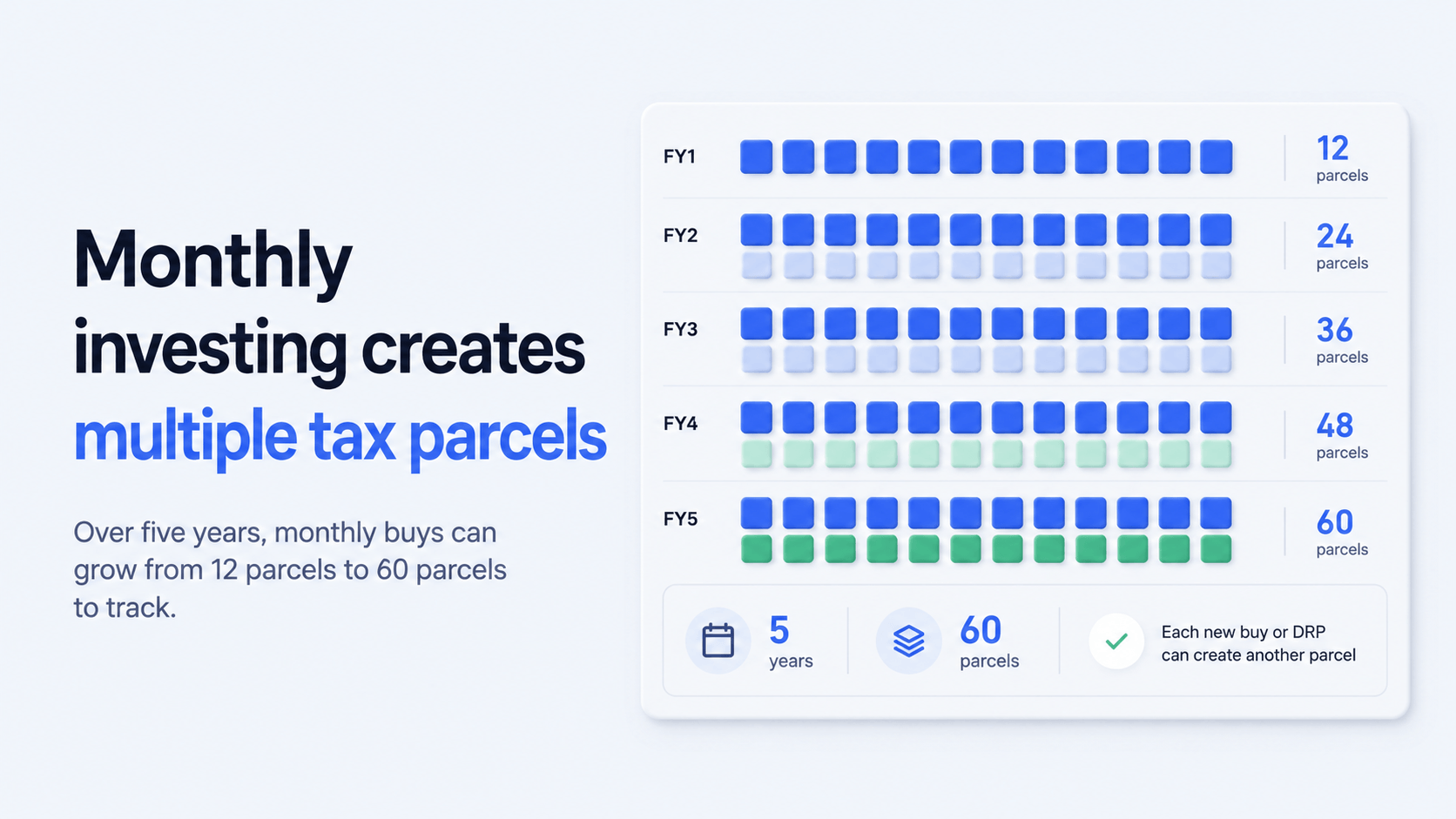
Keep the annual statement alongside the underlying trades and distributions. This makes it easier to review how the adjustment relates to the units you held, rather than rebuilding several years of history when you sell.
What happens when you sell ETF units?
When you sell part of a holding, you need records identifying the units sold. Different parcels can have different acquisition dates and adjusted cost bases.
The same sale, different parcel records
You bought 100 units at $10 and another 100 units at $15. You later sell 100 units at $20, receiving $2,000.
- First purchase
- 100 units × $10$1,000 purchase cost
- Second purchase
- 100 units × $15$1,500 purchase cost
The example excludes brokerage and adjustments. Your reporting must identify which units were sold and use the relevant records.
Methods such as FIFO (first in, first out), LIFO and manual parcel selection describe ways to allocate sold units to purchases. A method name alone is not a substitute for records supporting the allocation.
Keep a record of prior disposals so units already used in one sale are not counted again. Navexa can help compare estimated outcomes from recorded data; it does not decide which method is appropriate for your circumstances.
What about US and other foreign ETFs?
A fund’s domicile and structure affect the tax documents it provides. A US-domiciled ETF generally does not issue an Australian AMMA statement in the same way an Australian AMIT does.
Foreign holdings can involve foreign income, withholding tax, currency conversion and different reporting periods. Keep the provider and broker documents and ask a registered tax agent how they apply to your circumstances.
What about CGT changes from 1 July 2027?
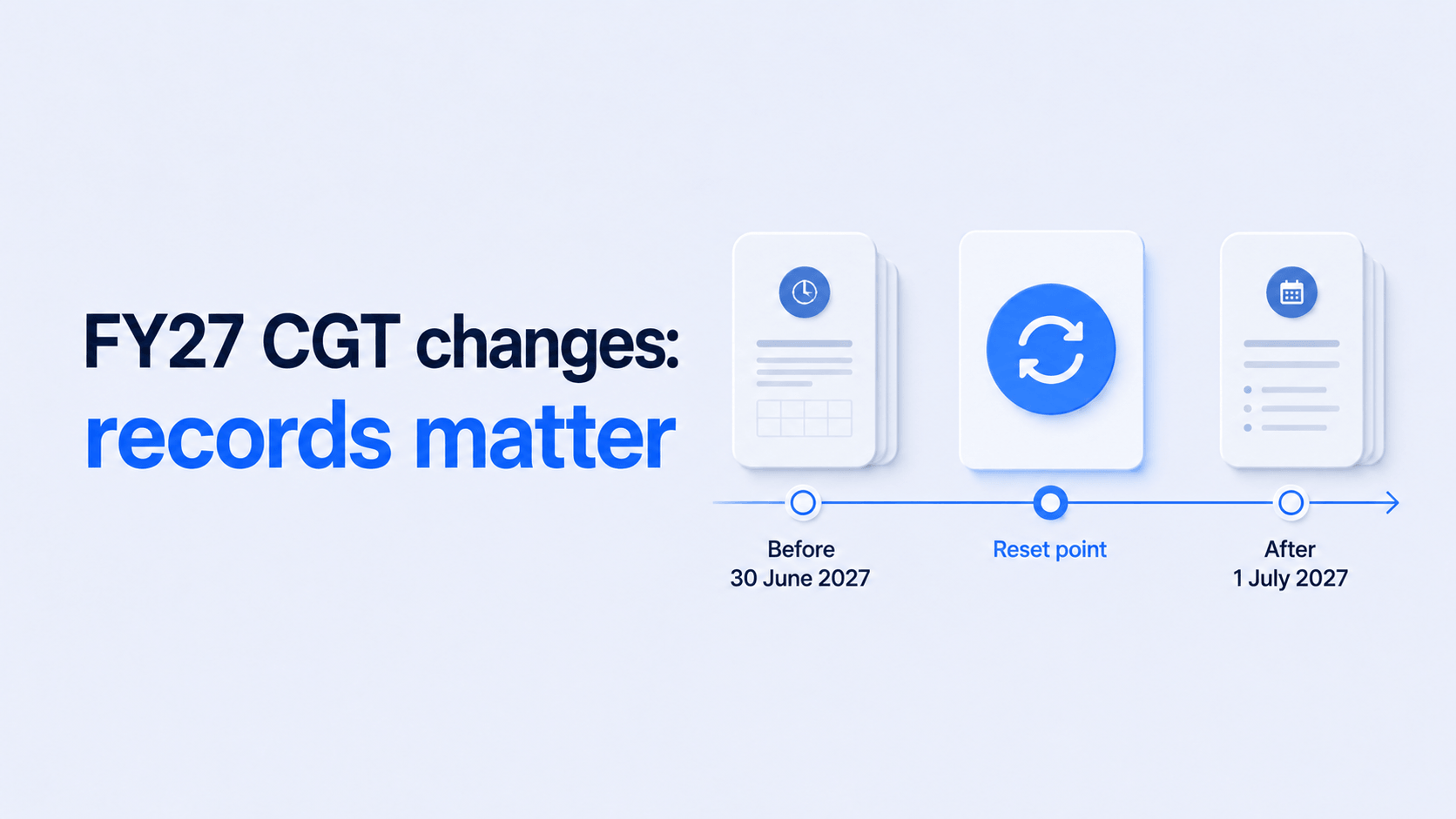
Treasury’s explanation of the 2026–27 tax reforms sets out changes from 1 July 2027, including replacing the 50% CGT discount with an inflation-based discount and introducing a minimum 30% tax rate on capital gains. It says the new arrangements apply to gains accruing from that date when realised.
This is separate from recording your annual AMIT adjustments. Keep your parcel history and source documents complete, and check the rules applying to the relevant year rather than applying a future-year rule to an earlier return.
Keep the records behind the numbers
- Final annual statementsKeep the AMMA or other tax statement for each relevant holding and financial year.
- Trades and reinvestmentsCheck purchases, sales, quantities, dates, brokerage and DRP entries.
- Tax components and adjustmentsRetain income components, offsets and any cost-base increase or decrease.
- Previous disposalsRecord which parcels were used for each sale and which remain.
How to record your AMIT/AMMA statement in Navexa
Navexa’s Australian tax reports require an AUD-base portfolio. Before starting, check that the correct holding, trades and distributions are recorded for the financial year shown on your final statement.
- Open the statement workflow. Go to Tax Reporting → Taxable Income, choose the financial year and find the holding under Trust Income. Select Enter AMIT Statement, or Update AMIT Statement if data is already saved. You can also start from the holding’s Income page.
- Choose one entry method. Enter the statement manually or import the PDF. Match values by their meaning and tax labels, and compare every imported amount with the original statement.
- Review and save. Check the holding, financial year and calculated totals, then select Save Updated Distributions.
- Check the saved result. Reopen the statement and review the updated distributions and Taxable Income report.
Follow the complete instructions for entering or importing an AMIT/AMMA statement and reviewing your Taxable Income report.
The Taxable Income report includes recorded income and fund-distributed components. Gains or losses from selling your own holdings are reviewed in the Capital Gains Tax report. Both depend on complete and correct portfolio data.
Common questions
Does an AMIT excess increase or decrease cost base?
It decreases cost base. Use the net excess shown on the final statement and account for the relevant units.
Does an AMIT shortfall increase or decrease cost base?
It increases cost base. The adjustment is part of your investment’s tax records, not an extra cash payment.
Do I need the statement if I haven’t sold any ETFs?
Yes, if your fund issues one. It can contain attributed income, fund-distributed capital gains and cost-base adjustments. An excess above the remaining cost base can also trigger a capital gain without a sale.
Can I rely on the cash distribution or ATO pre-fill alone?
Check both against your final annual statement. Cash received is not necessarily the taxable amount, and you still need records supporting your cost base and disposals.
Does Navexa replace an accountant or lodge my return?
No. Navexa helps organise and report portfolio data. It does not lodge your return or replace personal advice from a registered tax agent.
The ETF tax webinar with Pearler
Watch the original discussion and download the supporting slides. The recording reflects the information discussed at the time; check current guidance before using it for your tax return.
Bring your ETF records together
Keeping your statements, distributions and parcel history up to date makes tax reporting easier to review. Explore Navexa’s Australian tax reporting tools to see how your recorded investment data becomes reports you can check and share with your accountant.
If you use Pearler, you can also check the Navexa offer for eligible Pearler users. Navexa does not recommend Pearler, any broker, any financial product or any investment strategy.
General information only. This article does not constitute financial, legal or tax advice and does not take your personal circumstances, objectives or needs into account. Navexa provides portfolio-tracking and tax-reporting tools based on data recorded in your account. Tax rules, legislation and platform features may change. Speak with a qualified accountant, registered tax agent, financial adviser or legal professional before making decisions.